
Build vs. Buy: Why Custom Solutions Rarely Work for NDT Companies
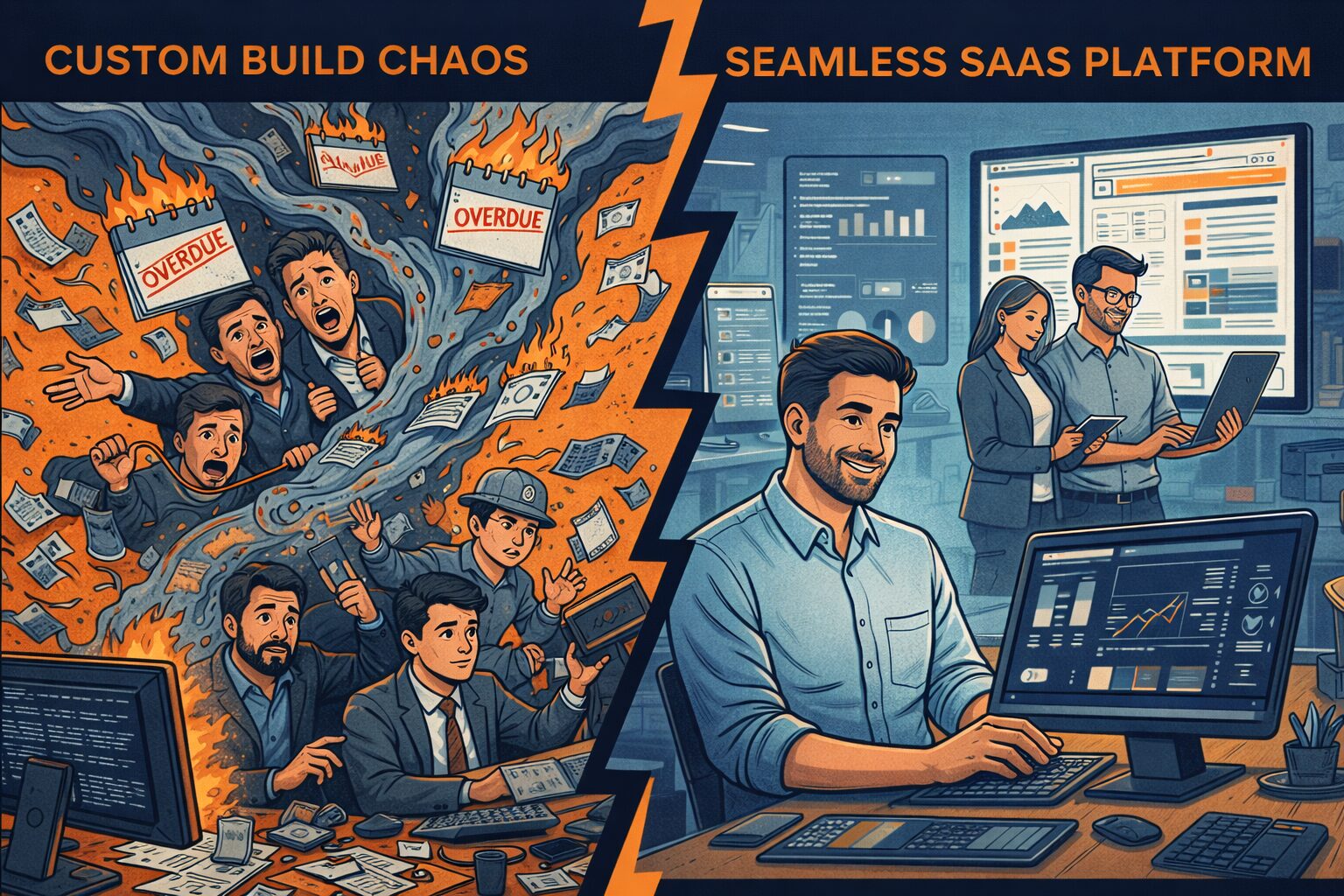
Many NDT companies consider building their own inspection management system at some point. The reasoning sounds logical: you know your processes best, so why not design software to match them exactly?
Here’s the reality: the build-vs-buy question looks different depending on your company size — but the answer is the same across the board. Small and mid-sized companies almost never have the IT bandwidth to build or maintain custom software. Larger companies that do have IT resources still face the harder problem: getting developers up to speed on NDT-specific workflows, then keeping pace as the software demands constant attention.
2025 Update: The AI Factor
The rise of AI tools like GitHub Copilot and ChatGPT has given more companies false confidence in building custom software. “AI can write the code for us” — and while it can accelerate development, AI doesn’t understand your NDT compliance obligations, ASME acceptance criteria, or why inspector certifications must be auto-tracked. AI generates generic code fast. NDT-specific knowledge still comes from years of domain experience. If anything, AI-powered commercial platforms now update faster than ever, widening the gap between purpose-built solutions and homegrown ones.
Before diving into costs, it’s worth being direct about who this decision actually affects — because the risk profile is different depending on where you sit.
The appeal is understandable. Here’s what companies tell themselves — and the reality that follows:
|
🕹️
Complete Control You design exactly what you want. Until the developer who built it leaves, and no one can change anything. |
🧩
Perfect Fit Every feature matches your workflow. Until your workflow changes — and now you need another sprint cycle. |
|
🔓
No Vendor Lock-In You own the code forever. But if your developer leaves, you’re locked into code only one person ever understood. |
🏆
Pride of Ownership Your system, your way. But your inspectors don’t care who built the software — they care if it works on-site. |
The Upfront Bill Is Just the Beginning
Custom software development often costs $200,000–$500,000 for the initial build. For a mid-sized inspection company, that equals 10–20 years of subscription fees for a commercial platform. But the real cost comes after deployment: bugs, features, security patches, and compatibility updates. Most companies spend 20–30% of the original development cost annually just to keep the system running.
And don’t forget: unless you already have a qualified developer on staff, you’ll need to hire one first — typically a $90,000–$130,000/year engineering role. That’s before a single line of code is written. Once the system is built, that person needs to stay on to maintain it. Custom software isn’t a project with a finish line; it’s an ongoing commitment that requires a dedicated technical resource for the life of the system.
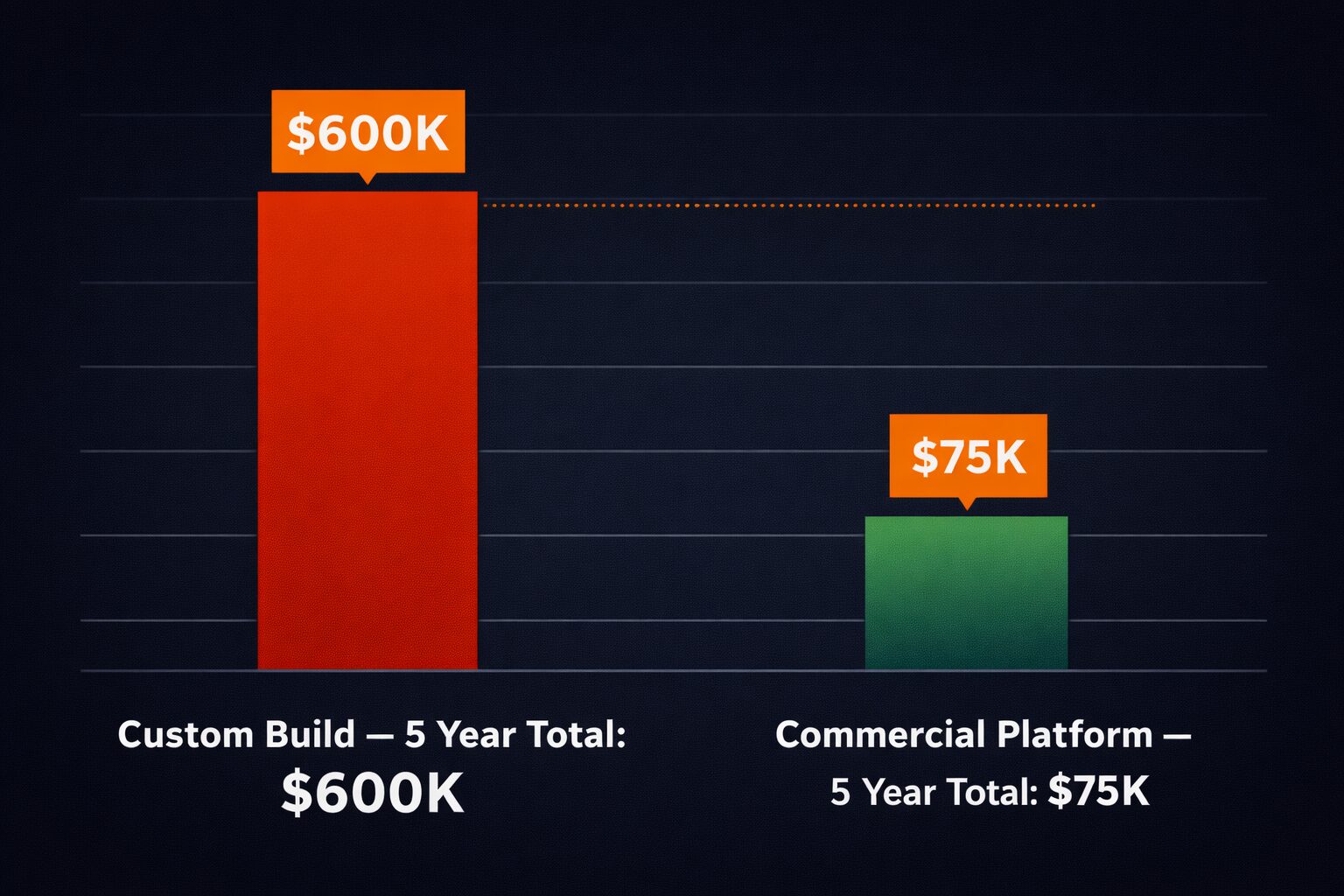
* Floodlight’s $15,000/year plan covers up to 20 users including unlimited inspectors and back-office staff. Custom build costs include developer salary, build costs, and ongoing maintenance — and do not include the cost of replacing that developer when they leave.
Development Takes Longer Than You Think
Your IT team says “six months.” Plan for 18. Software projects consistently run 2–3x over estimated timeline. Every decision becomes a debate. Meanwhile, competitors who adopted existing solutions 18 months ago are already seeing ROI.
“The complexity of NDT process workflows make it a tremendous investment for companies in terms of time, workforce, productivity, and process efficiency.”
— Frost & Sullivan Industry Analysis
Maintenance Becomes a Second Business
Software isn’t a build-once project. It requires ongoing bug fixes, security patches, mobile OS compatibility updates, and feature additions. What happens when your lead developer quits? For smaller companies this means a total standstill. For larger ones it means an expensive scramble to decode someone else’s codebase while managing day-to-day IT needs.
NDT Expertise Doesn’t Come From IT
Your developers might be excellent coders. But do they understand ASME Section V acceptance criteria? ISO 9712 certification requirements? Why an RT report needs different fields than a UT report? Generic developers build generic solutions. In NDT, that nuance matters.
You Only Learn From Your Own Mistakes
When you build custom software, you start from zero. Every workflow decision, every edge case, every compliance nuance — your team figures it out alone, often the hard way. Commercial platforms built for NDT carry the accumulated experience of hundreds of inspection companies. The workflows, templates, and compliance frameworks weren’t invented in a conference room; they were refined through real deployments across the industry. You don’t just get software — you get the benefit of every challenge those customers have already worked through.
Commercial platforms designed specifically for NDT aren’t compromises — they’re concentrated domain expertise.
|
⚡
Faster Time to Value Go live in weeks, not years. Floodlight implementations typically see first digital reports within the first week — not the first year. |
💰
Lower Total Cost Subscription models spread cost predictably. No capital expenditure, no surprise maintenance bills, no paying to fix bugs that shouldn’t exist — and no developer salary to carry. |
|
🔄
Continuous Improvement Updates and new features delivered automatically. When regulations change, the platform adapts — no developer sprint required. |
🔬
NDT Knowledge Built In Certification tracking, calibration audit trails, multi-standard compliance (ASME, API, ISO) — already embedded. You don’t need to explain NDT to your software. |
|
📋
Proven NDT Templates Pre-built inspection forms and reports developed from real NDT industry experience — save weeks of configuration time. |
🤖
AI-Enhanced Capabilities Modern NDT platforms leverage AI for report generation, anomaly flagging, and predictive scheduling — continuously updated for all customers. |
“Companies implementing comprehensive field service management software report productivity increases averaging 24% within the first year.”
— Field Service Management Software Statistics, 2025

📌 Something Worth Considering Before You Build
Companies often justify custom builds by pointing to unique requirements. And in some cases those are real. But it’s worth stepping back and looking at what most NDT operations actually have in common — because the list is longer than you might expect:
- ✓ Perform inspections across multiple NDT methods (UT, RT, MT, PT, VT)
- ✓ Track inspector certifications that expire and must be renewed
- ✓ Monitor equipment calibration linked to specific inspections
- ✓ Generate client reports in varying formats
- ✓ Maintain compliance with ASME, API, or ISO standards
- ✓ Schedule jobs and dispatch field technicians
- ✓ Invoice clients for completed work
The variations — Client A wants reports in inches, Client B in millimeters, Client C needs three signatures — are handled through configuration, not custom code. A purpose-built platform gives you that flexibility without requiring you to build it from scratch. Your genuinely unique requirements are almost always a much smaller slice of your total workflow than they appear at the outset.
It’s tempting to think generative AI has tipped the scales toward building. “We’ll use AI to write the code — that cuts development costs in half.” Here’s what that actually looks like:
- ✗ AI writes code fast — but has no embedded NDT compliance knowledge
- ✗ AI can’t test edge cases against ASME Section V acceptance criteria
- ✗ AI-generated code still requires engineers to review, test, and fully own the output
- ✗ AI won’t be on call when the system breaks before a client audit
- ✗ AI doesn’t update your software when API 510 publishes a new revision
- ✗ AI can’t onboard itself — every new developer still learns your codebase and NDT domain from scratch
That last point kills large-company custom builds over time. Developer turnover is constant. AI speeds up code generation — it doesn’t transfer institutional knowledge. Your custom system becomes a treadmill, not an asset.
Where AI does genuinely help is inside purpose-built commercial platforms — powering smarter report generation, automated anomaly detection, and intelligent scheduling — shipped continuously to all customers. A company starting a custom build today will be 2–3 years behind on AI features by the time their system is stable. The gap isn’t closing. It’s widening.
If you’re still considering custom development, get honest answers to these before committing:
- 1What’s our true 5-year budget including a developer salary and maintenance? (Multiply your IT team’s estimate by 3–4x.)
- 2Do we have a qualified developer on staff — or do we need to hire and retain one specifically for this project?
- 3What happens when our lead developer leaves? (This happens more than you think.)
- 4How will we keep up with iOS, Android, and browser updates? (Mobile platforms change constantly.)
- 5Who on our IT team understands NDT compliance requirements? (Hint: probably no one.)
- 6How long until we see ROI? (If it’s more than 6 months, competitors are already ahead.)
- 7Are we in the software business or the inspection business? (Be honest.)
We built the Floodlight NDT Efficiency Calculator so you don’t have to take our word for it. Input your real numbers and get your personalized efficiency score — plus a full PDF report you can share with your team.
| Inspector TimeA–F | Back OfficeA–F | DeliveryA–F | Rework RateA–F |
Takes 60 seconds. Delivers your annual waste in dollars and hours — and a roadmap to fix it.
Your core business is inspections, not software development. Every hour spent on custom development is an hour not spent on winning new contracts, improving inspection quality, training technicians, or serving clients.
Buying a proven, NDT-specific platform lets you focus on growth instead of code. Floodlight isn’t just software — it’s years of NDT expertise embedded in a system that evolves with your industry. The development cost is already spent. The NDT knowledge is already built in. The maintenance is already handled.
You focus on inspections. We focus on software.
“Efficiency gains from 25% up to 40% have been measured depending on the application. Field technicians no longer want to do any manual reports!!”
— NDT.net Community Discussion
Schedule a one-on-one demo and learn how digitalization pays for itself — often in the first quarter.