Month: January 2026

NDT Compliance Made Simple

NDT Compliance Software: Digital Record-keeping Made Simple

Introduction: Compliance Is the Core of NDT

It’s 9 AM Monday. An auditor just arrived unannounced. Do you feel confident or panicked?

Non-Destructive Testing isn’t just about finding defects—it’s about proving compliance. Whether it’s ASME codes, ISO standards, or client-specific requirements, inspection records are the evidence that work was done properly and safely.

NDT compliance software reduces record retrieval time from hours to seconds, and audit preparation time by up to 87%.

For many NDT companies, compliance is both a necessity and a burden. Paper files, Excel spreadsheets, and manual signatures make audits stressful and record-keeping inconsistent. NDT compliance software changes that, making audits simpler, record-keeping faster, and compliance more reliable.


The Challenges of Manual Compliance
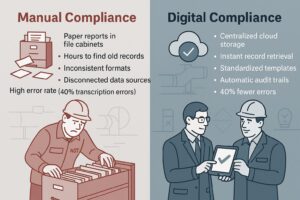
Inspector searching paper files - NDT compliance software eliminates this

1. Paper trails that disappear

Paper reports can be lost, damaged, or misfiled. When an auditor asks for a record from five years ago, finding it can take hours or days. Sometimes, you never find it at all.

2. Inconsistent record-keeping

Different inspectors use different formats. Missing data fields or inconsistent terminology create audit headaches. One inspector writes “pass,” another writes “acceptable,” and a third leaves it blank. Auditors notice.

3. Limited traceability

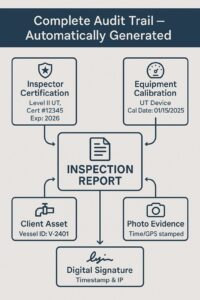
Auditors want to see the full chain: inspector qualifications, equipment calibration records, inspection results. In manual systems, these pieces live in separate file cabinets, folders, or someone’s truck. Connecting them during an audit means scrambling.

4. Regulatory risk

Failure to produce complete, traceable records can lead to fines, failed audits, or lost contracts. In some cases, it can shut down a job site until you prove compliance.

“Digital transformation pushes inspection software into the center of plant operations. DICONDE-compliant images seamlessly integrate with scanners and asset-management portals, eliminating paper logbooks and reducing transcription errors by 40%.”
Mordor Intelligence NDT Software Market Report

That 40% error reduction isn’t just about convenience. In compliance-heavy industries like NDT, errors in records can mean the difference between passing and failing an audit.


How NDT Compliance Software Simplifies Audits
Inspector using tablet on industrial site with digital inspection system

NDT compliance software like Floodlight is built around audit-readiness, not as an afterthought:

Centralized record storage

All inspection reports, certificates, and equipment records are stored in one secure system. No more hunting through file cabinets or calling retired inspectors to ask where they kept the 2019 turnaround records.

Standardized templates

Inspection forms ensure required fields are always captured, reducing the risk of missing data. If ISO 9712 requires a technician certification number, the system won’t let you submit a report without it.

Traceability built in

Each inspection is automatically linked to the technician, the equipment used, and the calibration status. This creates a complete audit trail without any extra work from your team.

Instant retrieval

Need a record from three years ago? Search and pull it up in seconds, not hours. Auditors appreciate speed, and so do clients who need documentation for their own compliance.

Customer portal access

Provide clients direct access to their inspection history, reducing back-and-forth requests. When an asset owner needs proof of last year’s vessel inspection, they can pull it themselves instead of calling you at 4:30 PM on a Friday.

“87% of customers believe it is important that companies be transparent about data and how it’s used, especially in regulated industries.”
Salesforce Consumer Trust Research

For NDT companies, transparency isn’t optional. Digital recordkeeping with client portal access shows your customers exactly what you’ve done and when, building trust that manual systems can’t match.


Why NDT Compliance Software Is a Competitive Advantage

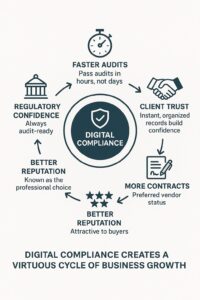
Meeting compliance isn’t just about avoiding penalties. It’s also about winning business:
Professional business meeting with digital presentation of inspection records

Clients trust companies with strong record-keeping

An asset owner deciding between two vendors will choose the one that can provide instant, organized reports. When your competitor shows up with a filing cabinet and you show up with a searchable database, the choice is obvious.

Audits become showcases instead of scrambles

Instead of panicking when an auditor arrives, you demonstrate professionalism and organization. You’re the company that has its act together. That reputation spreads.

Acquisitions favor digital-ready companies

Buyers look for businesses with standardized, reliable compliance processes. If you’re planning to sell in the next 5-10 years, digital recordkeeping directly increases your company’s value.

Regulatory requirements are getting stricter, not looser

“Over 60% of U.S. bridges, pipelines, and boilers now exceed design life, triggering tighter risk-based inspection schedules. Asset owners deploy enterprise NDT suites that automate anomaly detection and maintain audit trails.”
Mordor Intelligence NDT Market Analysis

As aging infrastructure demands more frequent inspections, regulatory scrutiny increases. The companies that can prove compliance quickly and thoroughly will be the ones that keep working.


See How Digital Recordkeeping Works

Watch a 5-minute demo of instant record retrieval and automated audit trails.

Schedule a Quick Demo

The Audit Scenario: Two Companies, Two Outcomes
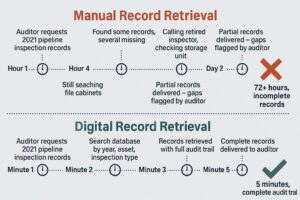
Split screen showing stressed manual audit vs calm digital audit

A refinery schedules an unannounced compliance audit.

Company A (manual) scrambles to find records. Files are missing. One inspector retired last year and took his records with him. Staff spend three days digging through file cabinets and old laptops. The auditor flags gaps in calibration records and inconsistent inspector certifications. The refinery delays the next project until compliance is proven.

Company B (digital with Floodlight) pulls up records instantly. Reports are consistent. Calibration records are automatically linked to inspections. Inspector certifications are current and attached to every report. The auditor spends two hours instead of two days and leaves satisfied. The refinery adds Company B to their preferred vendor list.

Six months later, when the refinery has another turnaround, which company gets the call?


What Digital Compliance Actually Looks Like

Here’s what changes when you move from manual to digital record-keeping:

Before (Manual) After (Digital)
  • Inspector fills out paper form in the field
  • Returns to office, types data into Excel
  • Saves file to shared drive (maybe)
  • Calibration cert is in a different folder
  • Inspector cert is in another folder
  • Client calls asking for records
  • You spend an hour hunting files and emailing PDFs
  • Inspector completes digital form on tablet in the field
  • Data automatically populates report with linked calibration and certification records
  • Report is instantly available in secure cloud storage
  • Client logs into portal and downloads it themselves
  • When auditor asks for it three years later, you search and send it in 30 seconds

The work doesn’t get harder. It gets automatic.


Common Concerns About NDT Digital Record-keeping

“What if we lose internet access?”

Most digital platforms work offline. Inspectors capture data in the field without connectivity, then sync when they’re back online.

“What about data security?”

Cloud-based systems like Floodlight use enterprise-grade encryption and regular backups. Your data is more secure than a filing cabinet that anyone can access.

“Will regulators accept digital records?”

Yes. Standards bodies and regulatory agencies accept and often prefer digital records. The key is ensuring your system maintains proper audit trails and cannot be altered without documentation.

“What if the system goes down?”

Reputable platforms have uptime guarantees exceeding 99.9%. Compare that to the risk of a fire, flood, or simple human error destroying your paper records.


Bottom Line: Compliance Doesn’t Have to Be Pain

Regulation is the backbone of the NDT industry. You can’t avoid it. But you can decide how much it costs you in time, stress, and lost opportunities.

With NDT compliance software, recordkeeping becomes a natural part of your daily work, not a separate burden you deal with when auditors show up.

Digital systems don’t just protect your company from fines and failed audits. They position you as the professional, organized, trustworthy vendor that asset owners want to work with.

The companies winning the best contracts aren’t the ones with the most certifications. They’re the ones who can prove their work instantly.

Ready to see the ROI for your company?

Schedule a one-on-one demo to learn how digitalization pays for itself, often in the first quarter.

Schedule a Demo

The Real Cost of Staying Manual

The Real Cost of Staying Manual: Why “Too Expensive” Is the Wrong Question

Introduction: Why the Monthly Fee Isn’t the Real Cost

When NDT service companies consider moving from paper and spreadsheets to a digital platform, one objection comes up repeatedly: “It costs too much.”

It’s natural to focus on the monthly subscription fee. After all, inspection companies run lean, and margins can be tight. But focusing only on the software cost ignores the hidden expenses of staying manual, costs that don’t appear on invoices but show up in wasted time, lost revenue, and higher risk.

The real question isn’t “How much does a digital platform cost?” It’s “What is the cost of continuing without one?”


The Hidden Costs of Manual Processes

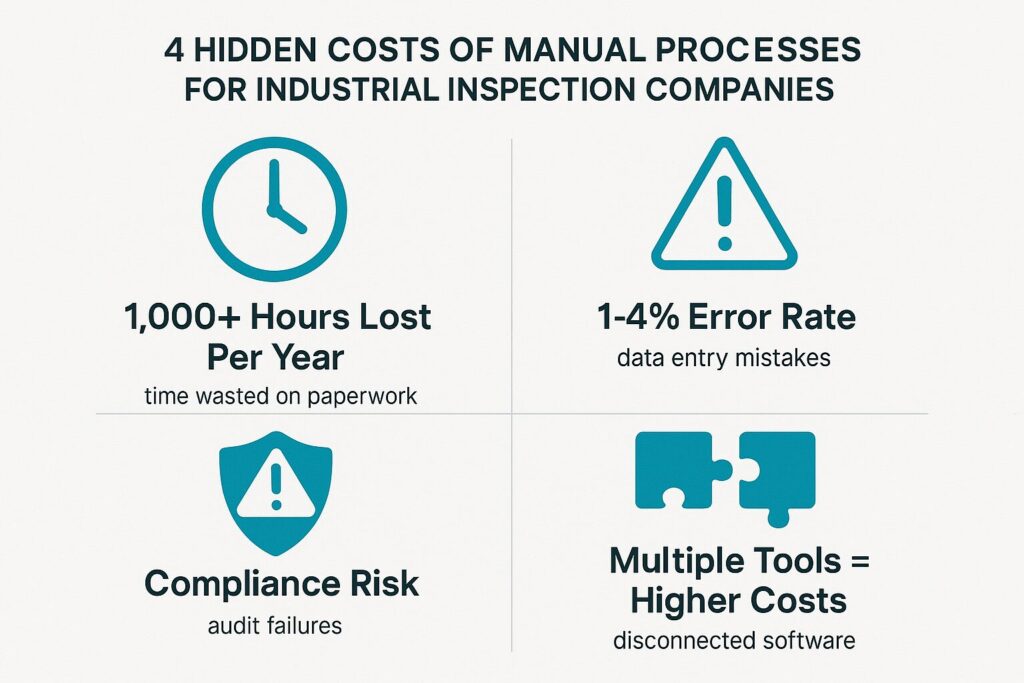
1. Time lost to paperwork

Inspectors often spend 2 to 3 hours after a field job transcribing handwritten notes into Excel or formatting reports in Word. For a 10 person company, even 2 hours per inspector per week adds up to 1,000+ hours per year lost to paperwork, the equivalent of half a full time employee doing nothing but administrative work.

That’s not inspection work. That’s not billable time. That’s pure overhead.

Industry Expert Insight:
“Admin tasks take up 30% of an average technician’s working hours — slightly more than the 29% they spend delivering their actual services.”
— Salesforce “3 Field Service Trends Today’s Leaders Need to Know”

2. Errors and rework

With manual data entry, mistakes are inevitable. A missing weld ID, a transposed measurement, or an incorrectly transcribed reading can delay projects, trigger re inspections, and frustrate clients. The cost isn’t just internal time, it’s also reputational damage and potential liability.

3. Compliance risk

NDT inspections exist to prove safety and compliance. Paper forms and spreadsheets are harder to audit, easier to lose, and more prone to inconsistency. A failed audit or lost certification record can result in fines, liability exposure, or worse: loss of client trust and future contracts.

4. Multiple disconnected tools

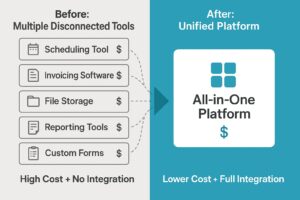
Most companies that aren’t on a unified platform are already paying for a patchwork of solutions: scheduling software, quoting apps, invoicing systems, file storage subscriptions. Each one comes with its own monthly fee, and none of them talk to each other.

When you add up these hidden costs, the subscription fee for a purpose built digital platform often looks small by comparison.


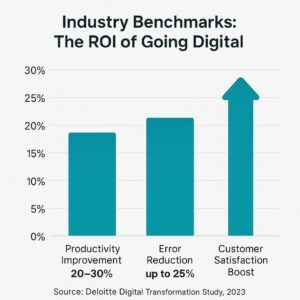
Industry Benchmarks: The ROI of Going Digital

Studies across field service and inspection heavy industries show consistent results:

    • 20 to 30% productivity improvements once workflows are digitized
      For a 10-person shop, that’s reclaiming 200-300 hours per year, enough to take on 2-3 more projects without hiring.
    • Error reduction of up to 25% when reports are standardized and automated
      Fewer callbacks, less rework, and happier clients who don’t have to ask for corrections.
    • Customer satisfaction improvements tied directly to faster reporting and easier record access
      Same-day reports and client portals mean more repeat business and referrals.

Digital Transformation Impact:
“Companies implementing comprehensive FSM software report productivity increases averaging 24% within the first year.”
— Field Service Management Software Statistics (September 2025)


Consolidation = Direct Savings

Floodlight isn’t just another tool you’re adding to your tech stack. It replaces multiple disconnected systems with a single platform built specifically for NDT:

  • Scheduling → Eliminate standalone dispatching tools
  • Quoting & invoicing → Replace general purpose accounting add ons
  • Reporting → Remove the endless Excel/Word formatting cycle
  • Customer portal → No need for separate file sharing subscriptions


This consolidation means you’re not just paying for software, you’re eliminating redundant costs and gaining integrated workflows that actually talk to each other.

Industry Analyst Perspective:
“Organizations that consolidate their technologies and shed their point solutions see cost savings almost immediately, as well as organizational and personnel efficiencies in the long run.”
— Imagine Software


What Digital Costs vs. What Manual Costs

When you’re weighing the decision to go digital, it helps to see the real numbers side by side. Below is what companies typically spend on software versus what they’re already losing to manual processes, broken down by company size.

Here’s the breakdown based on your company size:

Company Size Software Cost/Year Manual Waste/Year Net Savings
10-50 inspectors $7,800-$45,000 $88,000-$500,000 $43,000-$492,000
50-100 inspectors $45,000-$90,000 $438,000-$1,000,000 $348,000-$955,000
100-500 inspectors $90,000-$450,000 $875,000-$5,000,000 $425,000-$4,910,000
500-1,000 inspectors $450,000-$900,000 $4.4M-$10.0M $3.5M-$9.6M
1,000-2,500 inspectors $900,000-$2.25M $8.8M-$25.0M $6.6M-$24.1M
2,500+ inspectors $2.25M+ $22M-$25M+ $19.8M-$22.8M+

Bottom line: The software typically costs about 10-15% of what you’re already wasting on manual processes. The other 85-90% goes straight back into your business.

The real question: Would you rather keep losing $100,000+ per year to inefficiency, or spend $10,000-$30,000 to fix it?


What Happens If You Wait

Here’s what’s happening right now while you’re staying manual:

  • Your competitors are delivering same-day reports. How many repeat customers are you losing?
  • Asset owners are demanding digital portals. Some are already cutting manual companies from their approved vendor lists.
  • Auditors expect digital records. Paper files and spreadsheets don’t cut it anymore.
  • Buyers want digital companies. If you’re thinking about selling in the next 5-10 years, staying manual lowers your company’s value.

The longer you wait, the further behind you fall.

Competitive Reality:
“73% of consumers will switch to a competitor after multiple bad experiences, and more than 50% will switch after only one bad experience.”
— Zendesk Customer Service Statistics 2025


Case Example: Two Companies, Different Trajectories

Consider two 20 person inspection firms:

Company A (stays manual):
Inspectors spend ~6 hours per week on paperwork. Over a year, that’s ~6,000 hours lost, equivalent to 3 full time employees doing nothing but admin work. Reports often take days or weeks to finalize, causing frustration for clients as well as causing delayed payment on work performed. Clients complain about delays.

Company B (goes digital):
Inspectors log results directly in the field using tablets. Reports are generated automatically. Paperwork hours drop by 50%. Customers receive reports same day or next day. The company looks more professional, wins more repeat contracts, and improves margins.

Company B doesn’t just save thousands of hours annually—they also look more professional to clients, which translates into more contracts and higher margins.


Real World Impact:
“After implementing digital inspection workflows, our average report turnaround time dropped from 3 days to same-day delivery. We’ve seen a 40% increase in repeat business directly tied to our faster, more professional reporting.”
— Operations Director, Mid-Atlantic Inspection Services (Anonymous client quote)


The Bottom Line

When NDT owners say “It costs too much,” they’re usually comparing a visible monthly fee to hidden costs they’ve learned to live with.

But here’s what we’ve learned from working with hundreds of inspection companies: the cost of staying manual always exceeds the cost of going digital. Always. It just shows up differently, in lost hours, frustrated clients, missed opportunities, and lower company valuations.

The NDT industry is at an inflection point. Asset owners are demanding digital access. Auditors expect standardized records. And the next generation of technicians won’t tolerate paper forms and spreadsheets the way the current generation has.

The companies that recognize this shift early and act on it, will be the ones that dominate their markets over the next decade. They’ll win more repeat business, command higher margins, and build companies that buyers compete for when it’s time to exit.

The companies that wait? They’ll eventually be forced to digitize anyway however by then, they’ll be playing catch-up to competitors who’ve already built a reputation for speed and professionalism.

You can lead this transition, or you can follow it. But you can’t avoid it.


Ready to see the ROI for your company?


Schedule a one-on-one demo

Schedule a demo to learn how digitalization pays for itself, often in the first quarter.

Scroll to top